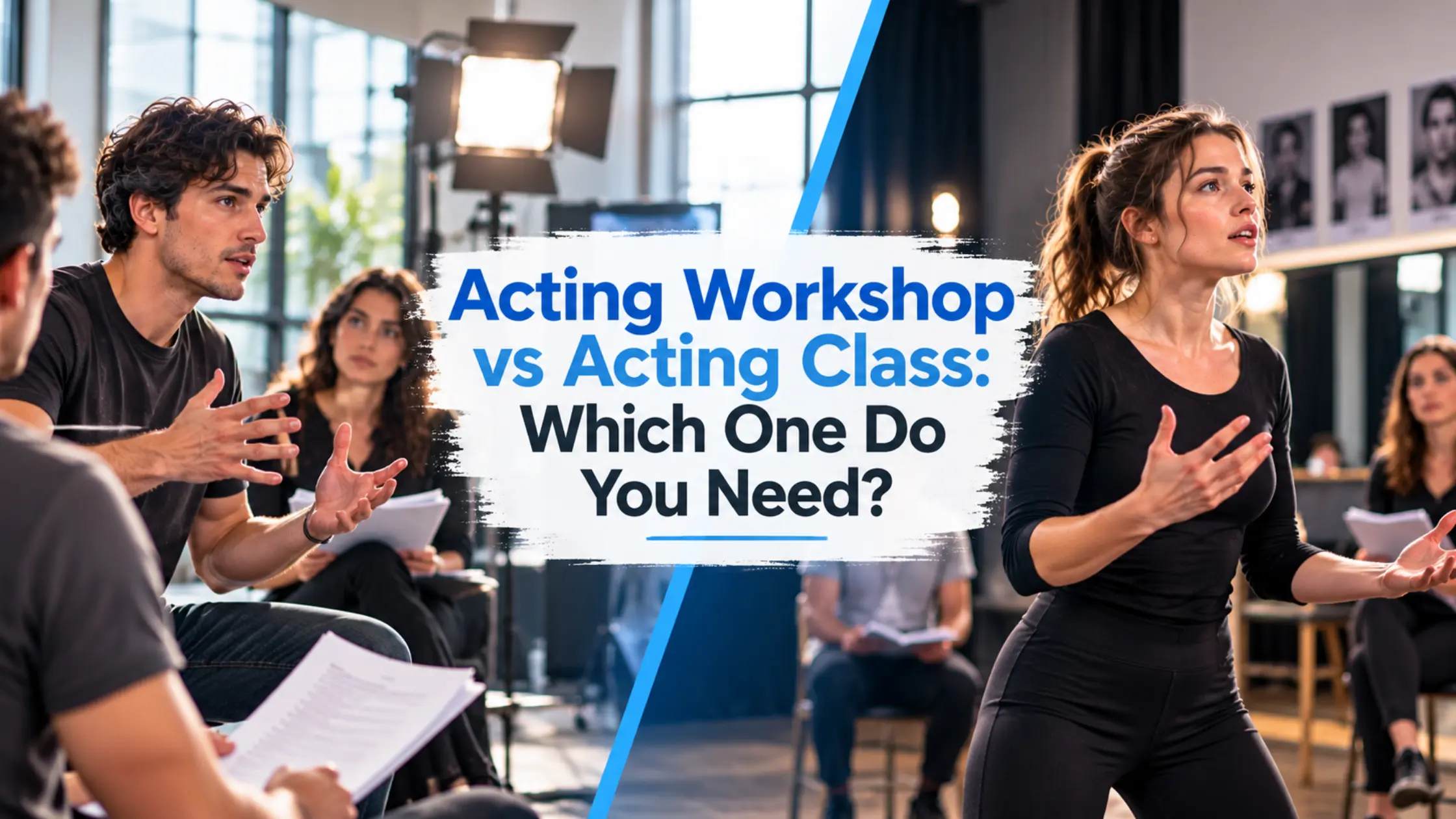
Most actors use these terms interchangeably. They are not the same thing, and choosing the wrong one at the wrong stage of your development can slow you down in ways that are not obvious until months later.
Here is what each one is, how they differ, and which makes sense for where you are right now.
What Is an Acting Class?
An acting class is a structured, ongoing training environment. You attend regularly, work through technique systematically, and build skills that compound over time. The instructor teaches a specific method, and every exercise serves that method’s development.
This is where you develop your instrument, how to break down a scene, build emotional range, and turn raw instinct into reliable craft.
The importance of training as an actor comes down to this: class builds the foundation everything else rests on.
What Is an Acting Workshop?
An acting workshop is a focused, short-form training event a day, a weekend, or a few concentrated sessions built around one specific skill or technique. Think cold reading, self-tape auditions, commercial technique, or on-camera close-up work.
Workshops are targeted, not foundational. They work best for actors who already have baseline training and want to sharpen a specific area or get feedback from a specialist.
For beginners without a foundation yet, the lessons will not stick.
Acting Class vs Acting Workshop: At a Glance
| Factor | Acting Class | Acting Workshop |
| Duration | Ongoing, weeks or months | Short-term, one day to a few sessions |
| Structure | Systematic, building over time | Focused on one topic or skill |
| Skill level | Beginner through advanced | Intermediate to advanced |
| Purpose | Foundation building | Skill sharpening or exploration |
| Instructor | Regular, knows your work | Often a guest or specialist |
| Commitment | Weekly schedule | One-time or short series |
| Best for | New and developing actors | Actors with existing training |
What Acting Classes Are Best For
Building a Technical Foundation
A class gives you a repeatable process on how to find your objective, connect to your scene partner, generate genuine emotion under pressure, and take a director’s note and apply it instantly. Without that foundation, you are guessing every time.
Acting advice for people just starting out consistently points back to this: the actors who build lasting careers build the technique first.
Long-Term Skill Development
Progress in acting is not linear and it is not fast. Showing up to class week after week, getting feedback, and trying again is what actually produces a skilled actor. A class gives you that sustained developmental arc no workshop can replicate.
A Community of Working Peers
A good ongoing class puts you in a room with serious actors over an extended period. You learn from watching others work, build relationships, and gain collaborations and referrals. That sustained peer environment is one of the most underrated benefits of class training.
What Acting Workshops Are Best For
Sharpening a Specific Skill
If you are already training and know you need work in a particular area, a workshop is the most efficient format to address it. A cold reading workshop will push your sight-reading further in two sessions than a generalist class will in a month. Workshops are effective because they go deep on one thing.
Exposure to a New Method or Instructor
Some workshops bring in guest instructors with specialized expertise or a different methodological perspective than your regular teacher. These are valuable for getting fresh feedback from someone who does not know your work. The guide on how to choose an acting coach applies equally to workshop instructors.
Audition Prep and Applied Technique
Many workshops focus on directly applicable skills: commercial auditions, booking co-star roles, self-tape submissions, or on-camera close-up work. These are most useful for actors who are actively auditioning, not those still in foundational training.

When to Choose a Class
Choose an acting class if you are:
- New to acting with no formal training yet
- Feeling like your foundation is inconsistent or unreliable
- Building a reel or audition materials and want strong scene footage
- Preparing to submit to agents and want your training credentials to carry weight
Whether acting school is worth it is worth sitting with before you commit. For most beginners, an ongoing class is the right starting point.
When to Choose a Workshop
Choose an acting workshop if you are:
- Already enrolled in ongoing training and want to supplement it
- Actively auditioning and need to sharpen a specific skill
- Interested in feedback from a guest instructor or industry professional
- At an intermediate level and ready to explore new methods
The Mistake Most Beginners Make
Treating a workshop as a shortcut to avoid the longer commitment of ongoing class. It does not work that way.
A workshop assumes you have something to build on. Without foundational technique underneath it, the skill being taught has nothing to attach to. You may feel energized in the room, but it will not hold under audition pressure because there is no internalized practice behind it.
I have seen this happen repeatedly. An actor attends a weekend workshop, feels ready, then falls back on instinct the moment they step into an audition. That is not the workshop’s fault. It is a sequencing problem.
Build the foundation first. Use workshops to extend it.
Bottom Line
If you are just starting out, an ongoing acting class is what you need. If you are already training and want to sharpen a specific area, a workshop is a smart addition. Build the foundation first, then use workshops to extend it.
Book a free class at The Actor’s Group Orlando and start with the training that makes everything else work.
FAQs
Are acting workshops worth it?
Yes, at the right stage. Workshops are high-value for actors with existing foundational training who want to sharpen a specific skill. They are low-value for beginners who have not yet built the technical base to apply what they learn.
Can I learn acting from workshops alone?
Not effectively. Workshops address one skill in a compressed timeframe. They cannot replace the sustained, repetitive practice across many techniques that build a reliable acting instrument.
How do I know if I am ready for a workshop?
If you have completed at least one full term of ongoing acting class training, you are likely ready. If you are brand new to formal training, start with class.
What is the difference between a scene study class and an acting workshop?
Scene study is an ongoing class format where students work on assigned scenes over multiple sessions. A workshop is short-term and focused, often led by a guest. Scene study builds character depth over time. A workshop sharpens a specific skill in a concentrated session.
How often should I attend workshops?
One or two targeted workshops per year, on top of ongoing class training, is a productive cadence for most working actors.
Can workshops help me get an agent?
Indirectly. Some casting director workshops give you direct exposure to industry professionals. But the more reliable path is strong on-camera training and quality reel footage. The guide on how to prepare for an audition covers what agents actually look for.