Most beginners assume these are two versions of the same thing. They are not. Stage and screen acting use fundamentally different muscles, and training for one without understanding the other is one of the most common mistakes new actors make.
Here is what sets them apart and which one deserves your attention first.
The Core Difference in a Single Sentence
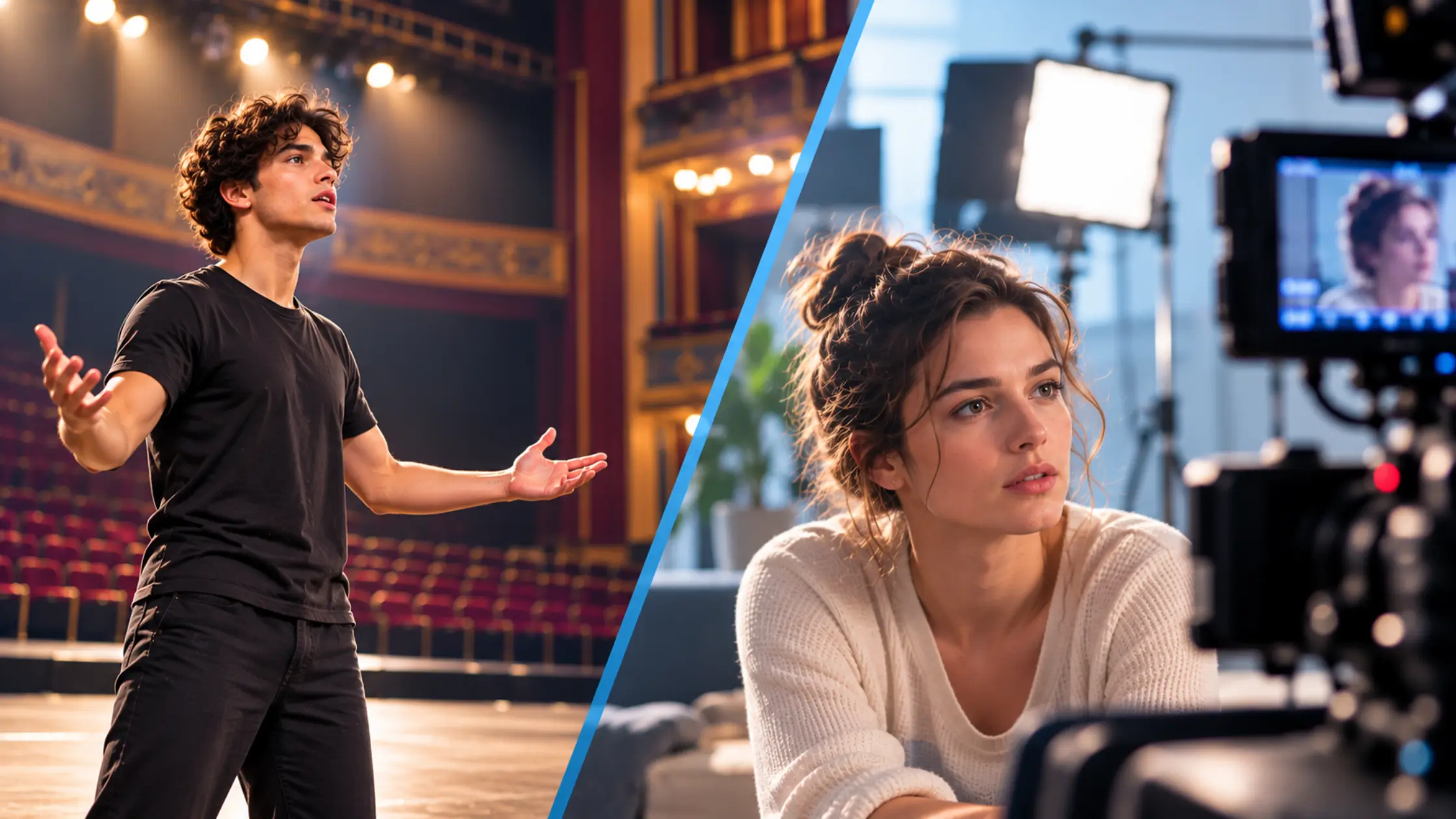
The stage is about projection and sustaining. The screen is about truth and economy.
What This Means in Practice
Everything else flows from that. The size of the audience, the scale of your physical choices, how you use your voice, where you put your eyes. All of it comes back to that single distinction. On a stage, you are filling a room. On a screen, the camera is three feet from your face and it catches everything.
Why Stage Habits Do Not Transfer
I have trained actors who were strong stage performers but completely lost on camera their first time in a scene. The habits that made them visible from the back row were exactly the habits that made them look unnatural in a close-up.
Understanding on-camera performance is a discipline in itself, not just a toned-down version of stage work.
Stage vs Screen: The Key Differences at a Glance
| Factor | Stage Acting | Screen Acting |
| Performance scale | Large, projected, theatrical | Small, internal, intimate |
| Voice | Full projection, shaped for acoustics | Conversational, mic picks up everything |
| Eyes | Broad, visible to back row | The eyes carry the scene |
| Movement | Deliberate, physical storytelling | Marks, stillness, controlled subtlety |
| Rehearsal | Weeks of rehearsal before performance | Limited rehearsal, shooting out of order |
| Memorization | Full script, beginning to end | Scene by scene, often single pages |
| Repetition | Same performance, night after night | Multiple takes, coverage, waiting |
| Audience feedback | Immediate, live, in the room | None. Just you, the lens, and the crew |
| Error correction | No stopping, you adapt and continue | Directors call cut and reset |
What Stage Acting Trains You For
Stage acting is a discipline machine. It builds the kind of foundational work ethic and physical commitment that translates into everything else you do as a performer.
Voice and physical presence
On stage, your voice is your primary instrument. You learn to project without shouting, shape words for clarity at distance, and sustain vocal performance across a full two-hour run. Your body has to tell the story from 50 rows away, which demands specificity in gesture and movement that most actors never develop otherwise.
Stamina and consistency
A stage run means performing the same show eight times a week, maintaining the same emotional reality night after night. That kind of sustained performance discipline is genuinely rare and it shows in the work of every stage-trained actor I have ever watched.
Script mastery
You memorize the entire play before you step on stage for opening night. There is no teleprompter, no continuity coverage, no editor to save a flubbed line. The sheer act of holding a full script in your body while performing live builds a relationship with text that screen actors often have to develop separately.
Connecting with a live audience
Stage acting teaches you to read a room in real time. You feel the audience. You adjust. That feedback loop develops a responsiveness and aliveness in performance that is hard to manufacture in a studio where you are performing for a camera crew.
What Screen Acting Trains You For
Screen acting strips everything away and asks a harder question. What are you actually thinking and feeling, right now, at this moment? The camera does not care how large your choices are. It cares whether they are true.
Subtlety and internal work
The camera magnifies everything. A thought lands. A micro-expression reads. Actors trained on stage often have to unlearn the scale of their choices before on-camera work clicks for them. Screen acting rewards the actor who does less and means more.
Hitting your mark and trusting the frame
On screen, the director and cinematographer are building a visual story. You are part of that frame. You have to hit your marks, stay in your light, and adjust your physical performance to what the camera is capturing rather than what feels right in the room.
It is a collaborative technical discipline that stage actors do not encounter until they step in front of a lens.
Self-taping and solo performance
The majority of professional auditions today happen on self-tape. You perform alone, to a camera, with no scene partner physically present, no live energy in the room, and no audience reaction to calibrate against.
That requires a specific kind of internal independence that screen training builds deliberately. For more on building that skill, the guide on acting advice for people who are just starting out covers the foundations.
Performing out of order
On a film set, you might shoot your final emotional breakdown scene on day one and your lighthearted opening scene on day five. Emotional continuity across fragmented shooting schedules is a skill unique to screen work. Stage actors perform beginning to end. Screen actors perform in whatever order the production schedule demands.
Where Stage Training Helps Screen Actors
Stage training is not wasted on a screen career. Far from it. Some of the strongest on-camera performers I have worked with came through theater first, and it showed in specific ways.
- Voice clarity and articulation translates directly to dialogue delivery on camera, especially in commercial and corporate work
- Text analysis skills developed through stage work make screen actors faster at breaking down a scene and finding the beats
- Physical specificity learned from stage performance gives actors more tools for making deliberate choices on camera
- Comfort performing under pressure with an audience present makes a crew-filled studio set feel far less intimidating
- Improvisation confidence built in live performance allows screen actors to adapt in the middle of a take without losing the scene
The mistake is assuming that stage training fully prepares you for the camera. It does not. But it builds a foundation that screen training then sharpens. Whether training matters at all is a question worth answering before you commit to either path.
Where Screen Training Helps Stage Actors
Actors who come to stage from a screen background bring a specificity and internal truthfulness that elevates stage work significantly. The intimacy developed on camera forces an actor to be genuinely present in a way that reads powerfully even at theatrical scale.
- Internal emotional work developed on camera makes stage performances feel lived-in rather than performed
- Economy of gesture learned on screen gives stage actors more precise physical storytelling tools
- Self-tape discipline translates into strong audition performance for stage roles, which increasingly use video submissions
- Cold reading ability required for screen auditions makes stage auditions feel significantly less high-stakes
Which Should Beginners Train For First?
This is the real question, and here is my honest answer after 40 years on camera: train for screen first.
Where the Work Is
Not because stage does not matter. It does. But the commercial market, corporate video, independent film, television, and digital content is where most working actors earn a living, especially in markets outside New York and major theater cities.
The self-tape audition has become the standard format in virtually every market. Agents who sign new talent are looking for on-camera presence, not stage credits.
What Screen Training Builds First
In my experience, beginners who start with screen training build the internal truthfulness that serves them in both worlds. Beginners who start with stage training sometimes spend years unlearning the habits the camera punishes them for.
Why Both Still Matter
No serious working actor stops at one. Stage auditions build performance discipline. Community theater builds credits when your reel is still thin. Improv classes build spontaneity that makes on-camera work feel alive.
Start with the screen. Add stages as you develop. Do not treat them as either-or once you are moving. The importance of ongoing training applies to both disciplines equally.
Conclusion
Stage and screen are not rivals. They are different tools for the same job. For beginners deciding where to put their energy first, the answer is on-camera training because that is where most professional work lives.
Book a free class at The Actor’s Group Orlando and start building the on-camera foundation that every serious acting career is built on.
FAQs
Is stage acting harder than screen acting?
They are difficult in different ways. Stage acting demands physical endurance, projection, and the ability to sustain a performance live with no safety net.
Screen acting demands emotional precision, technical awareness, and the ability to deliver truth in isolated fragments without the energy of a live room.
Most working actors find screen acting harder to master because the camera is unforgiving in ways a stage never is.
Can I do both stage and screen acting?
Yes, and most working actors do. The skills complement each other once you have solid foundational training in at least one discipline. Stage builds range and discipline. Screen builds precision and internal truth. The strongest performers I have worked with are fluent in both.
Does a theater background help you get cast in film and TV?
It helps with certain things, specifically text work, physical commitment, and audition confidence. But it does not replace on-camera training.
Many casting directors and agents in film and television markets look specifically for on-camera training when they review a submission, not stage credits alone.
How long does it take to transition from stage to screen acting?
It depends on how deeply the stage habits are ingrained. Some actors make the adjustment within a few months of dedicated on-camera training. Others take longer because the scale and physicality of stage performance is deeply embedded.
The key is consistent work with a qualified on-camera instructor who can identify and address the specific habits that do not translate.
What is the biggest mistake stage actors make when moving to screen?
Playing in the back row. Stage actors are trained to project every choice outward to fill a room. On camera, that reads as over-acting immediately. The adjustment is not about doing less. It is about redirecting that energy inward, trusting that the camera will find it.
Do I need to choose one or the other when starting out?
Not permanently. But early in your training, splitting focus between two very different techniques before either is solid can slow your development in both. Start with one, build genuine fluency, and then add the other. Most beginners benefit from starting with on-camera work because that is where auditions and professional work most commonly begin.